
What We Wear When No One Is Watching
On Danielle Mckinney, Black women at rest, and the way fashion rises to meet a moment
There is a particular version of a Black woman the world is accustomed to seeing: she’s capable, composed, productive, prepared. She is dressed for the meeting, the dinner, the flight, the photograph, the expectation. Even her ease can become a performance, yet another thing to execute beautifully.
Danielle Mckinney paints the Black woman who exists after all of that. Who is she when she is home, doing nothing, no performance, no audience, and truly experiencing sacred rest?
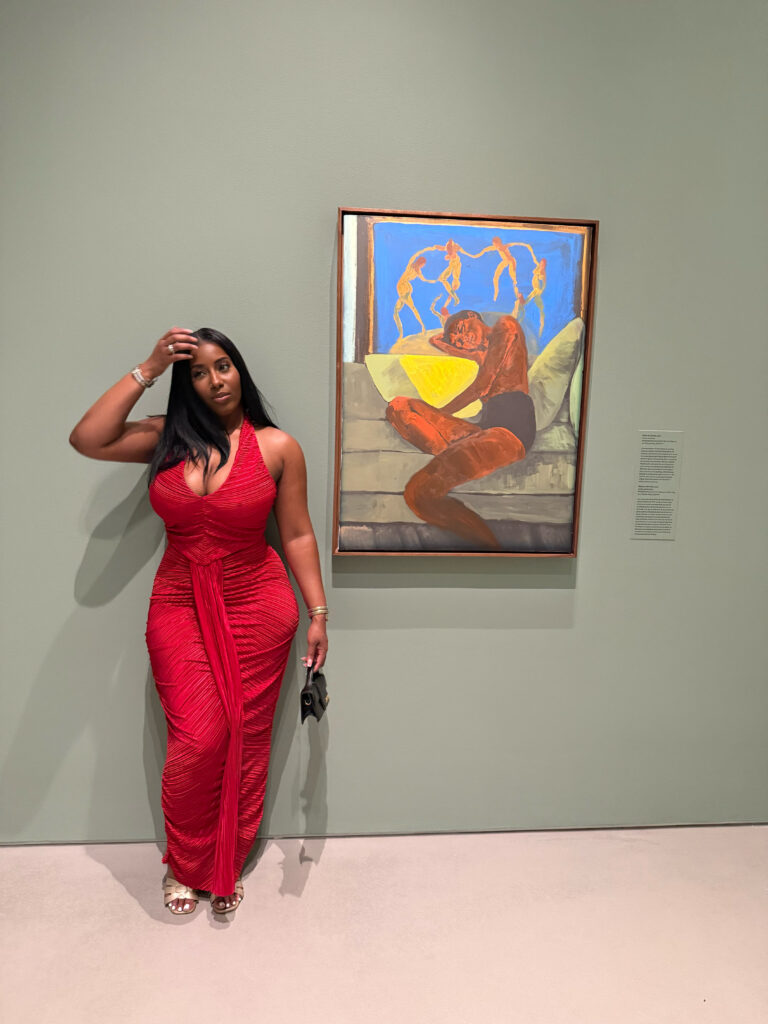
Standing beside Danielle Mckinney’s She, 2023, at the Norton Museum of Art.
Now, getting to this exhibit was an irony itself. I drove from Port Saint Lucie to a dentist appointment in Miami, met with my sister Kim for lunch, and changed in a hotel bathroom before meeting my bestie Shanice. Posed beside the partially undressed woman in She, I became aware of two expressions of feminine self-possession sharing the same frame. I had dressed to enter a public space and meet the significance of the evening. She appears liberated from the weight of perception altogether: shoulders loose, body unguarded, taking up space without asking what anyone will make of her. One woman is adorned for the gaze; the other seems entirely free from it. Neither expression is less authentic. Together, they reveal how womanhood can hold presentation and privacy, visibility and interiority, all at once.
In Danielle Mckinney: Shelter at the Norton Museum of Art, Black women recline, read, think, smoke and simply sit. They inhabit dimly lit interiors that feel at once familiar and unreachable. We are allowed close enough to recognize something in them, but never close enough to possess them. The Norton describes this tension as the pull between a shared emotional experience and “the essential unknowability of the subject.” That distance matters. These women do not owe us an explanation.
As a Black woman, I felt the weight of that immediately.
As much as I truly love my rest, I am used to a life measured by movement. There is always somewhere to go, something to finish, someone to show up for and another version of myself to become. Rest can sometimes feel like the space between meaningful events rather than a meaningful event of its own. Mckinney reverses that logic. In her paintings, stillness is not an intermission. It is the story.
The private self
Mckinney has said that her work considers a deceptively simple question: Who am I when I get home and no one else is around? Her women appear beyond the public-facing façade, in the hours when the body finally softens and the mind is free to wander. Historically, Black women in Western art were often pushed to the margins, shown working or serving, if they were pictured at all. Mckinney centers them and allows them to command the room without performing for it.
That is why the solitude in these works does not read as loneliness. It reads as ownership.
The women possess their time. They possess their bodies. They possess the right to be unknowable, even while being seen. There is something radical in that privacy because Black womanhood is so often treated as public property, our labor requested, our choices analyzed, our strength presumed. In Mckinney’s world, a woman can withdraw without disappearing. She can be still without becoming insignificant.
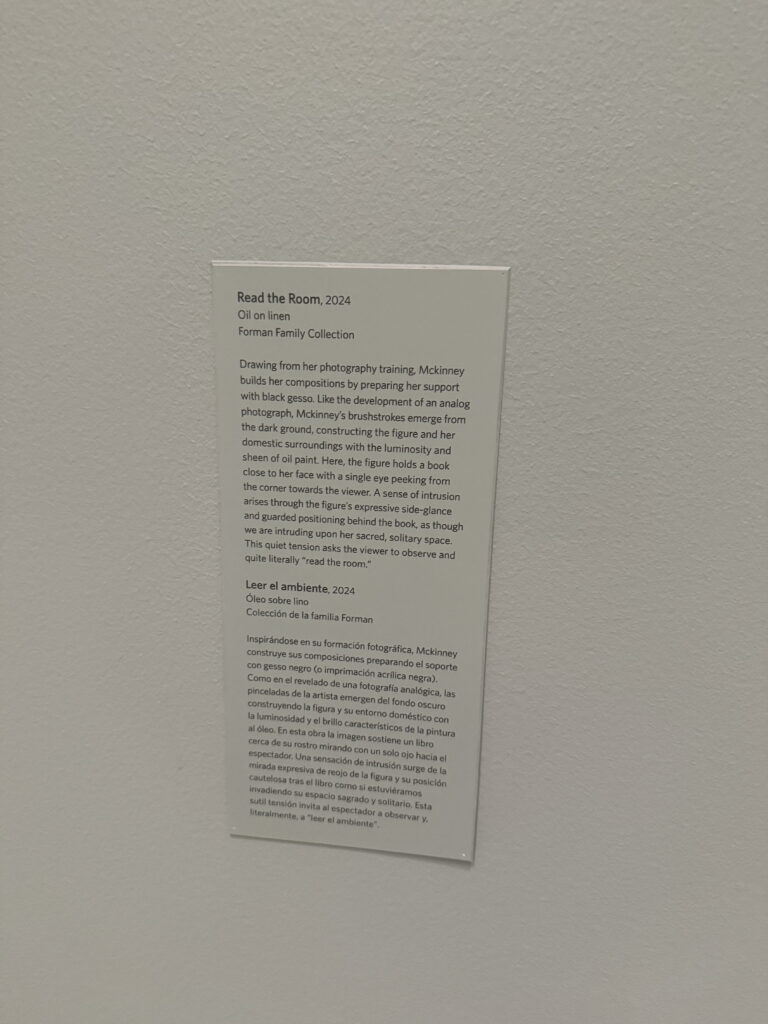
In Read the Room, that right to privacy becomes almost confrontational. The woman holds a book close to her face while one eye looks toward us from the corner. Her sideways glance changes the viewer’s role: we are no longer innocently looking at a woman reading; we have been caught entering her sacred, solitary space. The title becomes an instruction. She may be visible, but visibility is not consent to unlimited access. For Black women, so often expected to remain available, legible and emotionally accommodating, the guardedness feels like a boundary rather than a rejection.
Cigarettes, smoke and the ritual of release
The cigarettes recur so often that they become their own visual vocabulary. A lit tip interrupts the darkness. Smoke curves through the room, both present and impossible to hold. The cigarette can suggest indulgence, rebellion, appetite or danger, but in these paintings it also creates a boundary around a private ritual.
Mckinney has described smoking as an honest part of her own interior life: a pause she reaches for through happiness, grief and reflection. She has also spoken about the physicality of that pause, not only taking a breath, but holding the ritual in her hand. The point is not to romanticize smoking. It is to understand the cigarette as an outlet, a small release valve. It marks a few minutes in which nothing is being demanded of the woman holding it.
Psychologically, bringing something to the mouth can feel regulating because it combines repetition, touch, breath and sensory focus. It gives anxiety somewhere physical to go. I do not read this through the old, overly simple idea that every mouth-centered habit proves an “oral fixation.” I see a learned loop: the body attaches relief to a familiar sequence until the ritual begins to signal safety before the substance even arrives. That makes the cigarette in Mckinney’s paintings both an outlet and a trap, an instrument of agency that also reveals vulnerability, a chosen pause that may no longer be entirely a choice.
In Golden Hour, a relaxed woman smokes among elegant mid-century furnishings as warm light gathers around her. The title refers to photography’s fleeting period of luminous light near sunrise or sunset, but it also describes a threshold: the day loosening its grip, the public self giving way to the private one. The cigarette punctuates that transition. Its glow joins the glow of the room, turning an addictive habit into part of the composition’s beauty without erasing the contradiction inside it. She looks at ease, but ease and dependence can occupy the same body.
The smoke makes that release visible. It is the exhale given form.
Other details function in much the same way. A book shields a face. A lamp creates a pool of sanctuary. A sofa receives the full weight of a body. Red nails and flashes of metallic color emerge from the shadows. Each object offers another way inward while preserving the woman’s mystery.
The fashion is part of the language
Clothing carries its own emotional charge throughout Mckinney’s work. Her women appear in feather-trimmed pajamas, silk, velvet, robes and kimonos, and sometimes without clothing at all. These choices tell us how the body relates to the room.
Soft fabric signals permission to soften. A robe suggests the hours before a woman has assembled herself for public view, or after she has decided the performance is over. Feathers bring glamour into privacy. Bare skin can communicate comfort rather than availability. Even the polished nails complicate any easy division between being “done” and being at rest. A woman does not have to abandon adornment to belong to herself.
This is where fashion becomes more than an outfit.
An outfit does not contain one fixed story on its own. A slip dress at a celebration, on a city street and on a woman curled into her own sofa is not the same image. The garment may be identical, but the moment changes its meaning. Location, light, posture, memory and intention activate the clothes.
That is also why stylists matter. Styling is not simply the work of making someone look good. A good stylist understands context and ensures that clothing meets the emotional scale of the moment. The look must speak to where the wearer is going, what the occasion asks of her and who she has decided to be when she arrives. Fashion becomes storytelling through placement.
Mckinney approaches her painted worlds in a similar way. She has spoken about constructing environments from photographs, magazines and social imagery, much as she once built rooms from shoeboxes as a child. She selects the figure, the interior, the clothes and the objects, then freezes them together. No single element carries the entire narrative. Their relationship does.
The result feels cinematic because every detail has been styled. Not toward spectacle, but toward emotional truth.
Dressing to witness
Going to see art is also a moment, and I believe in dressing to meet it.
What I wear to a museum does not explain the work on the walls, nor does it need to. But it helps locate me inside the experience. The clothes become part of how I remember the day: what season of life I was in, how I felt walking into the room and what I understood differently when I left.
To stand before Mckinney’s women as a Black woman is to become both observer and reflection. I recognize the rituals, the fatigue, the desire for beauty, the need for a room of one’s own. I also recognize the tension between adornment and freedom. I love fashion not because I believe clothes tell us everything about a woman, but because they can honor the version of her that a particular moment calls forward.
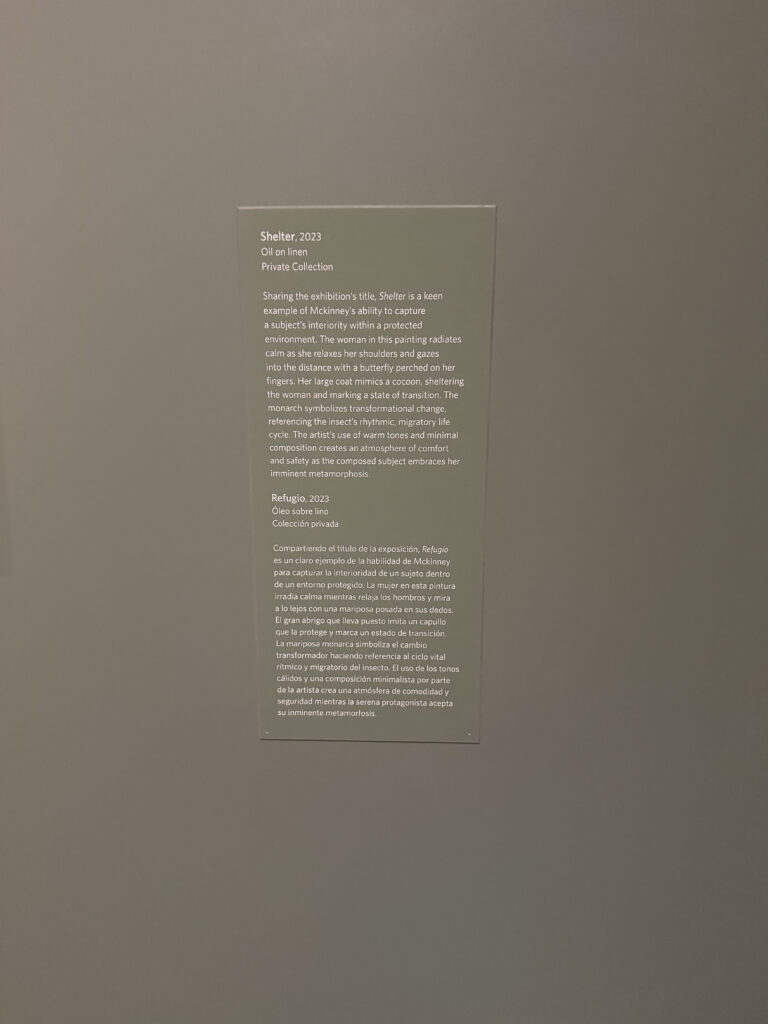
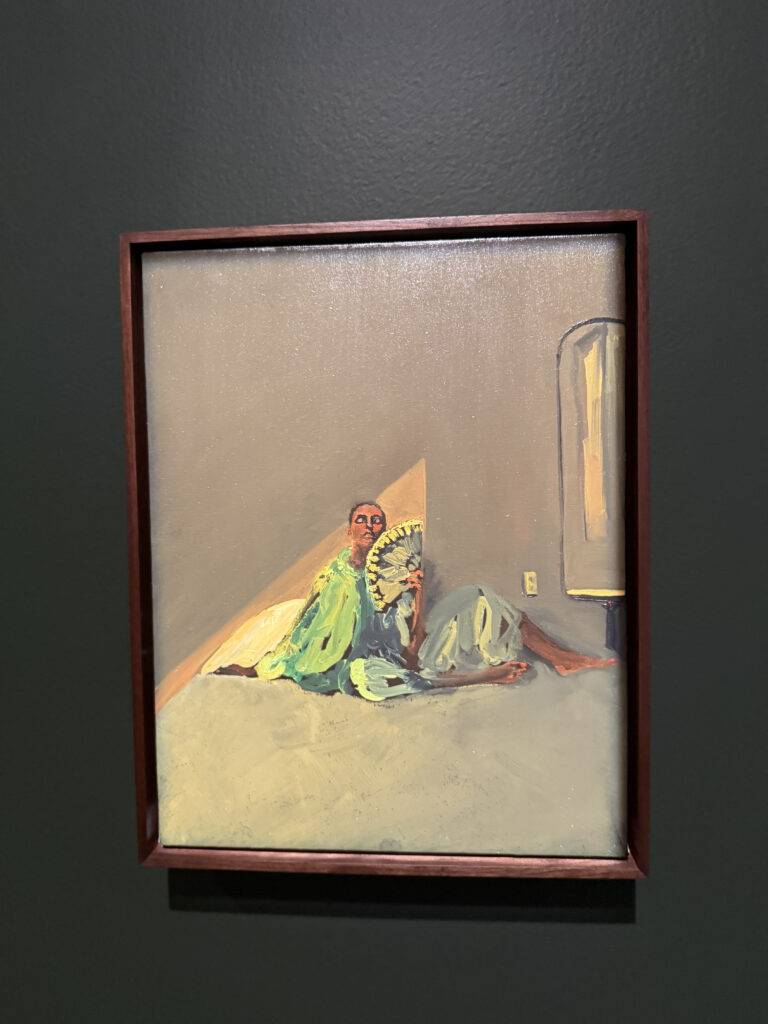
Shelter made that recognition especially personal. A woman sits inside a large coat that functions almost like a cocoon, a monarch butterfly resting on her fingers. Her clothing does more than cover her; it creates the protected conditions for transformation. The butterfly signals change, but the painting does not force that change into spectacle. Metamorphosis happens quietly. The woman does not appear to be chasing her next self. She is sheltered while it arrives.
Approaching thirty-five, I have been thinking about what it means to shed an old life without immediately turning the new one into another performance. I have spent years filling my calendar, dressing for the occasion and arriving as the woman the moment required. Shelter reminded me that becoming also needs privacy. Sometimes the most important transformation is not the entrance. It is the unseen interval when a woman finally feels safe enough to soften.
Sometimes that is the woman making an entrance. Sometimes it is the woman returning home to herself before the entrance is made.
The life a garment holds
As I viewed Danielle McKinney’s art work, I though “How does fashion do this?” Clothing acquires significance through experience. A piece can hold a birthday dinner, a gallery opening, a first date, a solo trip or an ordinary evening that later reveals itself to have changed everything. When the garment moves to another woman, its life does not end. Its meaning expands. That ties in with the mission behind my brand, Concrete Roze.
Concrete Roze is not only about access to fashion. It is about circulation, context and community: allowing beautiful pieces to meet more women and more moments. In a culture that pushes us to consume constantly and present a new self just as quickly, rewearing, exchanging and sharing clothing can be its own act of authorship. We decide that value is not exhausted after one appearance.
Mckinney’s paintings remind me that the same is true of women.
We are not only valuable in motion. We are not most compelling when we are producing, performing or being perceived. There are entire worlds inside the moments no one applauds—the ‘cigarette break’, the robe, the book, the quiet room, the long exhale.
Fashion can help us meet the moment. But the woman gives the moment its meaning.
Danielle Mckinney: Shelter is on view at the Norton Museum of Art in West Palm Beach, Florida, through October 4, 2026.
Sources and further reading
- Danielle Mckinney: Shelter — Norton Museum of Art
- The Interior Lives of Danielle McKinney — Vogue
- Danielle Mckinney, the Painter Depicting Black Women Revelling in Rest — AnOther
- Danielle Mckinney: Comfort and Quietude — Juxtapoz
- Danielle Mckinney’s Portraits of Black Women at Rest — Hyperallergic
- In Conversation with Danielle Joy Mckinney: The Empathetic Witness — Boston Art Review
- Tobacco, Nicotine, and Vaping — National Institute on Drug Abuse